
Content Updated: October 1, 2026
Qui tam is a type of lawsuit based on an ancient writ in common law that allows a private person, known as a qui tam relator, to prosecute a lawsuit for the government and receive a reward.
The False Claims Act (FCA) authorizes qui tam lawsuits to assist the government in prosecuting cases to recover damages and penalties for fraud against the government. If the case is successful, the qui tam relator can earn a whistleblower reward.
Table of Contents
Use the below links to navigate to FAQs about qui tam cases:
- What is a qui tam lawsuit?
- What does qui tam mean?
- How is qui tam pronounced?
- What is a qui tam relator?
- Who can become a whistleblower and file a qui tam lawsuit?
- How can whistleblowers safely report fraud and file a qui tam case?
- What happens after a qui tam lawsuit is filed?
- What happens when a qui tam lawsuit is unsealed?
- How long do qui tam cases take (on average)?
- What are the rewards for qui tam whistleblowers?
- How are qui tam whistleblowers protected?
- What are examples of qui tam cases?
- What are the requirements for a qui tam whistleblower?
What is a qui tam lawsuit (or qui tam action)?
Qui tam lawsuits are a type of whistleblower lawsuit that is brought under the False Claims Act, a law that rewards whistleblowers in successful cases where the government recovers funds lost to fraud. Many states also have false claims acts that prohibit fraud against the state government, which can be enforced through a qui tam lawsuit.
A qui tam lawsuit (also called a qui tam action) is a powerful way for whistleblowers to help the government stop many kinds of fraud and recover money for the US Treasury and American taxpayers. Some of the types of fraud alleged in qui tam claims include Medicare and Medicaid fraud, defense contractor fraud and procurement fraud. Qui tam lawsuits have helped to recover billions that have been stolen from the US Treasury and taxpayers.
Whistleblowers may report tax frauds, securities law violations and commodities law violations under other US whistleblower protection and reward programs, but those do not allow qui tam lawsuits.
What does qui tam mean?
Qui tam literally means “in the name of the king” and is short for the Latin phrase “qui tam pro domino rege quam pro se ipso in hac parte sequitur,” which roughly translates to “he who brings an action for the king as well as for himself.”
The qui tam phrase originated in England in the Middle Ages, when the king enlisted the public to help report violations of the law with the promise of a reward. The False Claims Act statute, under which qui tam lawsuits are typically filed, was passed on March 2, 1863, during the American Civil War. For more about the origins of the False Claims Act, the qui tam definition, and its provisions, see History of the False Claims Act.
How is qui tam pronounced?
Qui tam is most commonly pronounced “kee tam,” with the second word rhyming with “Sam.” “Kwee tam” and “kwee tom” are also used.
What is a qui tam relator?
A qui tam relator is a legal term for the private individual or entity that files a qui tam lawsuit. The qui tam relator may be more than one individual or even a business or a partnership. A qui tam relator has certain defined rights under the False Claims Act, such as the right to pursue qui tam cases on their own, if the government declines to join.
Qui tam relators have received rewards totaling nearly $10 billion since the False Claims Act was amended and strengthened in 1986. The Department of Justice reports $9,963,696,036 in relator share awards from Oct. 1, 1986 through Sept. 30, 2025.
Who can become a whistleblower and file a qui tam lawsuit?
Any individual with information about fraud against the government may become a whistleblower and bring a qui tam lawsuit. This is often an employee of the company committing the fraud, but it also can be a competitor, a contractor or anyone else who has information about the fraud.
An attorney files the qui tam lawsuit on behalf of the whistleblower, who is called a “relator” in qui tam cases. The qui tam lawsuit and supporting documents should provide the government with specific information about the fraud. Two provisions of the False Claims Act can affect whether someone can bring a qui tam case. The first-to-file bar generally prevents another whistleblower from bringing a related action while an earlier case based on the same underlying facts is pending. The public disclosure bar can limit cases based on allegations that have already been publicly disclosed, unless the whistleblower qualifies as an original source. Whether either restriction applies depends on the facts and timing of the case.
A qui tam lawsuit under the False Claims Act can be based on any of the following violations by an individual or entity:
- Knowingly presents, or causes to be presented, a false or fraudulent claim for payment or approval.
- Knowingly makes, uses or causes to be made or used, a false record or statement important to a false or fraudulent claim for payment or to an obligation to pay or transmit money or property to the government.
- Knowingly conceals or knowingly and improperly avoids or decreases an obligation to pay or transmit money or property to the government.
The False Claims Act defines “knowingly” more broadly than its common usage. It includes not only actual knowledge of wrongdoing but also deliberate ignorance or reckless disregard for the truth. This means even without intent to defraud, individuals can be held liable for false claims if their actions meet this standard.
If you know of fraud against the government, contact Phillips & Cohen for a free, confidential review of your potential case.
How can whistleblowers safely report fraud and file a qui tam case?
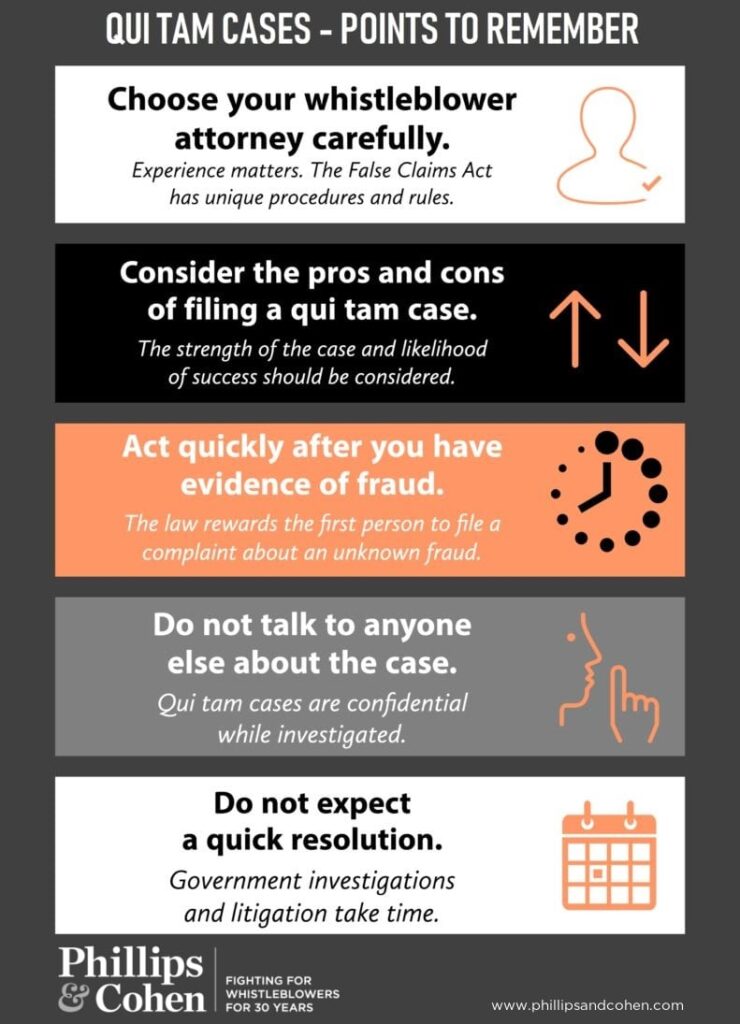
Selecting the right lawyer is crucial for a successful qui tam case. An experienced qui tam attorney understands the unique procedures and rules of the False Claims Act, ensuring your rights are protected. Thorough research and careful consideration should inform the decision about consulting and hiring a qualified qui tam lawyer.
Phillips & Cohen evaluates whistleblower cases at no charge and represents clients on a contingency basis, meaning clients pay attorney fees only if the case is successful and they receive a reward. Explore our resources to learn: tips when choosing a whistleblower lawyer, advice from a successful whistleblower, and pitfalls to avoid when filing a Qui Tam case.
There are important decisions to consider when becoming a whistleblower and filing a qui tam case. Taking a few key steps and choosing your qui tam attorney carefully can make a big difference in the success of your case.
Step 1: Consult with a Qui Tam Attorney
The False Claims Act mandates that a whistleblower must have an attorney to file a qui tam case. A qualified qui tam attorney will help you prepare a comprehensive complaint detailing the fraud and how it violates the law.
Step 2: File the Qui Tam Lawsuit Under Seal
The qui tam lawsuit is filed in federal district court “under seal,” meaning it is kept confidential so that only the government is aware of the case. The seal gives the government time to investigate the allegations and determine whether it will join the whistleblower’s case.
Step 3: Qui Tam Case Review and Government Intervention Decision
During the sealed period, the government conducts a thorough investigation into the whistleblower’s allegations. The government will then decide whether to intervene in the qui tam lawsuit, joining the whistleblower as a plaintiff. If the government intervenes, it takes a more active role in the litigation. If the government declines to intervene, the whistleblower can still proceed with the case independently. The case remains sealed until the government’s decision, after which the qui tam case becomes public.
What happens after a qui tam lawsuit is filed?
After a qui tam case is filed, the government investigates the allegations and determines whether it will join, or “intervene,” in the qui tam case. The False Claims Act states that a qui tam case will be sealed for 60 days while the government conducts its investigation, but courts generally extend the seal period to give the government more time to complete its work.
The government does not intervene in every qui tam lawsuit. When the government intervenes, it has primary responsibility for prosecuting the case, although the whistleblower remains a party. If the government declines to intervene, the whistleblower may still pursue the case independently, and declined qui tam cases can still result in substantial recoveries. The government may also ask the court for permission to intervene later upon a showing of good cause. DOJ statistics covering Oct. 1, 1986 through Sept. 30, 2025, show that qui tam matters where the government intervened or otherwise pursued the matter produced more than $53.1 billion in settlements and judgments, while declined qui tam matters produced more than $7.86 billion.
Defendants found liable under the False Claims Act may have to pay as much as three times the government’s losses plus penalties for each false claim. Most successful qui tam cases are resolved through settlement negotiations rather than a court trial, although trials may occur.
What happens when a qui tam lawsuit is unsealed?
When a qui tam case is unsealed, it means the complaint and the underlying allegations become public. The unsealing of the case can occur under several circumstances:
- Government Decision to Intervene: If the government decides to intervene and take over the prosecution of the case, it will unseal the complaint and proceed with the litigation.
- Government Declines to Intervene: If the government declines to intervene, the whistleblower and their attorney have the option to pursue the case on their own. The complaint will be unsealed, and the defendant will be notified of the lawsuit.
- Court Orders: Sometimes, the court may order the case unsealed for other reasons, such as legal motions or settlements.
Once the qui tam case is unsealed, the defendant becomes aware of the allegations and the whistleblower’s identity. This initiates the public phase of the litigation, where both parties engage in discovery, motions, and potentially trial or settlement negotiations.
How long do qui tam cases take (on average)?
Qui tam cases can be complex and lengthy, often taking several years to resolve. On average, these cases can take anywhere from 3 to 5 years, though some can take even longer depending on various factors, such as:
- The complexity of the fraud
- The amount of evidence and documentation required
- The level of cooperation from the defendant, and other involved parties
- The extent of the government’s investigation and intervention decision
During this period, the qui tam case remains under seal to allow the government time to investigate and decide whether to intervene.
What are the rewards for qui tam whistleblowers?
The False Claims Act rewards whistleblowers whose qui tam lawsuits are successful. The law offers rewards to encourage whistleblowers to come forward, recognizing the professional and personal risks they often take to expose and stop fraud against the government – fraud that can endanger the lives of patients, members of the US military and others.
If the government intervenes in the qui tam case and the case is successful through a settlement or a trial, the whistleblower, or “qui tam relator,” is entitled to 15 percent to 25 percent of the amounts collected by the government. If the government declines to intervene in the case and the whistleblower successfully pursues it, the whistleblower reward is between 25 percent and 30 percent of the amounts collected.
The exact amount of the whistleblower reward depends on many factors, including the quality of the information presented to the US Department of Justice (DOJ) and the work of the whistleblower and their attorney to help the qui tam case succeed.
Phillips & Cohen has won for their clients more than $1 billion in whistleblower rewards – more than any other law firm that handles qui tam and whistleblower lawsuits.
How are qui tam whistleblowers protected?
Whistleblowers can safely report fraud and file a qui tam case. Those who file qui tam lawsuits are covered under the qui tam provisions of the False Claims Act that prohibit retaliation for filing a qui tam action or for attempting to stop violations of the False Claims Act. The law covers company employees as well as independent contractors and agents.
The False Claims Act provides relief for an employee, contractor or agent who “is discharged, demoted, suspended, threatened, harassed, or in any other manner discriminated against in the terms and conditions of employment.”
Whistleblowers who suffer from retaliation in a qui tam lawsuit may sue for reinstatement, double back pay, and additional damages, where appropriate.
For more information, please see our page on whistleblower retaliation.
What are examples of qui tam cases?
Qui tam lawsuits can involve many kinds of fraud against government funds or property, including healthcare fraud, defense contractor and procurement fraud, education or grant fraud, mortgage and housing fraud, customs or tariff fraud, and cases where a company improperly avoids paying money owed to the government. Explore common qui tam cases and examples.
- Phillips & Cohen wins $37 million SEC whistleblower award for clients
- Prime Healthcare, its founder, and doctor pay $37.5M in whistleblower kickbacks, Stark case
- PPOA pain management clinics pay $24.5M to settle whistleblower cases
- West Virginia hospital agrees to pay $50M to settle whistleblower case alleging Stark and Anti-kickback violations
What are the requirements for a qui tam whistleblower?
To qualify as a qui tam whistleblower under the False Claims Act, several key requirements must be met:
- Original Information: The whistleblower must possess non-public, original information about fraud against the government. This means the information should not be already known to the government or public through media or other sources.
- Voluntary Disclosure: The whistleblower must voluntarily provide the information to the government.
- Filing a Complaint: The whistleblower must file a qui tam complaint under seal in federal court. This allows the government to investigate the allegations without the defendant’s knowledge.
- Substantial Contribution: The whistleblower’s information must substantially contribute to the successful prosecution of the case. This is crucial for determining eligibility for any financial reward.
- Timeliness: Federal False Claims Act qui tam actions are subject to strict statutes of limitations. In general, an FCA civil action must be filed by the later of: (1) six years after the alleged FCA violation, or (2) three years after the responsible U.S. government official knew or reasonably should have known the material facts, but never more than 10 years after the violation. FCA retaliation claims must be filed within three years after the retaliation occurred.
Why whistleblowers choose Phillips & Cohen for qui tam cases
Phillips & Cohen LLP is the nation’s most successful law firm representing whistleblowers in “qui tam” (False Claims Act) lawsuits. On behalf of whistleblowers, our lawyers bring qui tam cases involving Medicare fraud and other types of fraud under federal and state false claims laws.
Qui tam lawsuits brought by Phillips & Cohen on behalf of whistleblowers have returned more than $13 billion to the US Treasury, making it by far the top whistleblower law firm in the country. We have won more than $1.1 billion in total whistleblower rewards for our clients.
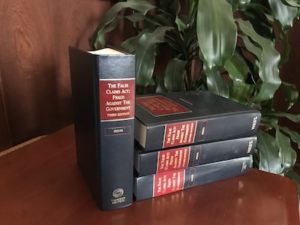
Phillips & Cohen’s lawyers have represented whistleblowers in qui tam lawsuits for 30 years. A founding partner of the law firm worked closely with Congress to write and pass the modern-day False Claims Act and its qui tam provisions. Another partner is the author of a leading legal reference on the False Claims Act and qui tam lawsuits, The False Claims Act: Fraud Against the Government, that is cited in qui tam cases and court rulings.
Phillips & Cohen attorneys are nationally recognized experts on qui tam lawsuits and other types of whistleblower cases and are frequently quoted in publications such as The New York Times and The Wall Street Journal. Several of our qui tam cases have been profiled on 60 Minutes and other news shows.
If you are aware of fraud against the government or qui tam violations and would like to discuss your options, please contact Phillips & Cohen for a free, confidential case review.