
An FCPA whistleblower is an individual who reports suspected Foreign Corrupt Practices Act violations, such as bribery of foreign officials or accounting and internal-control violations, to U.S. authorities. A whistleblower who provides original information to the SEC may report anonymously through an attorney and may qualify for an award of 10% to 30% of the money collected when an SEC enforcement action orders more than $1 million in sanctions.
What FCPA violations can whistleblowers report?
The Foreign Corrupt Practices Act (FCPA) is a federal anti-corruption law with two main components: anti-bribery provisions and accounting provisions. FCPA whistleblowers may report suspected bribery of foreign officials, falsified corporate records, or failures to maintain adequate internal accounting controls.
Anti-bribery violations: The FCPA prohibits covered companies and individuals from corruptly offering, promising, authorizing or providing money or anything else of value to a foreign official to influence an official action, secure an improper advantage or obtain or retain business. The anti-bribery provisions can apply to issuers, U.S. companies and individuals, and certain foreign persons or entities that act in furtherance of a corrupt payment while in U.S. territory. Covered parties may include officers, directors, employees, stockholders, agents, consultants, distributors and joint-venture partners.
Who is considered a foreign official? The FCPA broadly defines a foreign official to include officers and employees of foreign governments, government departments, agencies or instrumentalities, and public international organizations, as well as individuals acting on their behalf. Depending on the circumstances, foreign officials may include ministry employees, military procurement officials and employees of state-owned or state-controlled entities.
Books, records and internal-controls violations: The FCPA’s accounting provisions require issuers to maintain accurate books, records and accounts and an appropriate system of internal accounting controls. FCPA whistleblowers may report conduct such as disguising bribes as consulting fees or commissions, using false invoices or off-the-books accounts, falsifying corporate records or circumventing internal controls.
Who enforces the Foreign Corrupt Practices Act (FCPA)?
The CFTC does not enforce the FCPA. However, foreign bribery or corruption may also violate the Commodity Exchange Act when it involves fraud or manipulation in commodity or derivatives markets. In those circumstances, a whistleblower may also submit a separate tip through the CFTC Whistleblower Program.
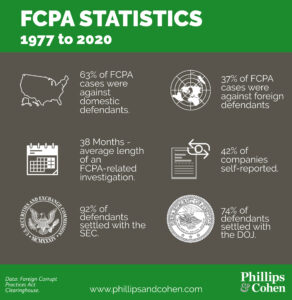
The SEC and the Department of Justice, which jointly enforce the FCPA anti-bribery law, have pursued a number of significant FCPA whistleblower cases in recent years.
Whistleblowers are playing a key role in FCPA enforcement. They can provide information about FCPA violations to the SEC by filing a confidential whistleblower claim — and even remain anonymous if they file a whistleblower claim through an attorney. By filing a SEC whistleblower claim, whistleblowers are entitled to a reward based on the monetary sanctions the US collects in the FCPA case.
Congress passed the FCPA in 1977, spurred by several foreign bribery scandals, including two separate cases against Northrop Corp. and Phillips Petroleum. Those companies’ use of corporate funds to bribe foreign officials was exposed by one of Phillips & Cohen’s founding partners and his public interest law firm at the time.
Who can be an FCPA whistleblower?
An FCPA whistleblower may be an employee, executive, consultant, agent, contractor, business partner or other individual with information about suspected bribery of foreign officials or related FCPA accounting violations. The individual does not have to work for the company being reported.
International whistleblowers may report FCPA violations even if they are not U.S. citizens and live outside the United States. They may still be eligible for an SEC whistleblower award, subject to the SEC Whistleblower Program’s requirements.
What rewards can FCPA whistleblowers receive?
Eligible FCPA whistleblowers may receive an award through the SEC Whistleblower Program equal to 10% to 30% of the monetary sanctions collected in a successful SEC enforcement action and certain related actions. To qualify, a whistleblower must voluntarily provide original information that leads to an SEC enforcement action resulting in more than $1 million in monetary sanctions.
Examples of major FCPA enforcement actions
FCPA enforcement actions can result in substantial corporate penalties. The following cases illustrate the scale of FCPA enforcement, although the settlement amounts should not be interpreted as publicly confirmed whistleblower awards.
- Airbus SE, a French company, paid more than $3.9 billion in 2020 to resolve FCPA and foreign bribery charges brought by authorities in the United States, the United Kingdom and France.
- Petrobras, Brazil’s state-controlled energy company, paid $1.78 billion in 2018 to resolve FCPA charges stemming from payments to politicians and political parties in Brazil.
- Ericsson, a Swedish telecommunications company, paid more than $1 billion in 2019 to resolve FCPA charges.
How do FCPA whistleblowers report violations?
Potential FCPA and securities-law violations may be reported to the SEC through its online Tips, Complaints and Referrals portal or by submitting a hard-copy Form TCR. A whistleblower seeking an SEC award must follow the program’s submission requirements, even if the information has already been reported to another government agency.
FCPA whistleblowers may submit information anonymously through the SEC Whistleblower Program, but an individual who wants to remain anonymous and preserve potential award eligibility must be represented by an attorney. The SEC generally protects information that could reasonably reveal a whistleblower’s identity, subject to applicable legal exceptions.
Depending on the facts, potential criminal FCPA violations may also be reported to the Department of Justice Criminal Division’s FCPA Unit. An experienced FCPA whistleblower attorney can evaluate whether information should be submitted to the SEC, DOJ or both and help ensure that applicable whistleblower award requirements are followed.
Are FCPA whistleblowers protected from retaliation?
Federal law may protect some FCPA whistleblowers from retaliation such as firing, demotion, suspension, harassment, or other workplace discrimination. Under Dodd-Frank, an individual generally must report a possible federal securities-law violation to the SEC in writing to qualify for the law’s anti-retaliation protections. An internal report alone does not provide Dodd-Frank protection.
Sarbanes-Oxley may separately protect certain employees who make qualifying reports internally or to government authorities. The protections available and the deadlines for pursuing a retaliation claim depend on the whistleblower’s employer, role, reporting method, and the conduct reported. An attorney can help determine which whistleblower retaliation protections may apply.
How can an experienced FCPA whistleblower attorney help?
Before deciding whether to become an FCPA whistleblower, it generally is a good idea to discuss your options and the benefits and risks with an experienced whistleblower lawyer.
If you would like to discuss your potential whistleblower case involving an FCPA violation or other securities law violation with a Phillips & Cohen attorney, please use our whistleblower contact form for a free, confidential review of your case.
Thousands of whistleblowers file whistleblower claims annually with the SEC. With our extensive experience with the SEC whistleblower program, Phillips & Cohen knows how to evaluate and present whistleblower claims to the SEC in a clear and effective way, which benefits their clients.